Before the Byline: How News Desks Took Shape
How newsroom desks took shape: trace an invented harbor report from scattered notes to an edited story, and see how division of labor shapes news.
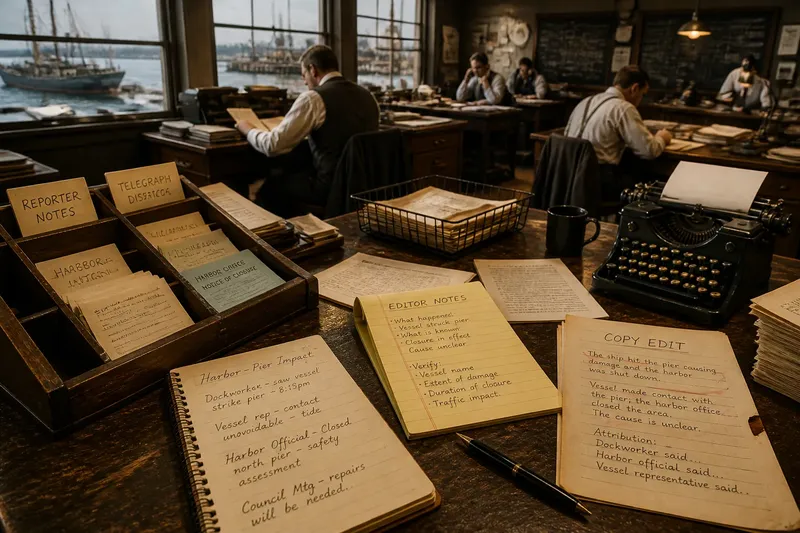
The common mistake in describing newsroom desks is to treat job titles as fixed boxes with a settled history. That can obscure the practical problem: a paper had incoming material to sort, check, shape, and move toward publication. How newsroom desks took shape depended on each publication’s workload and workflow, so the available evidence does not support one universal timeline.
Say an evening paper in an invented harbor town receives word that a cargo vessel struck a pier. A reporter is covering a council meeting, a telegraph dispatch offers a brief account, the harbor office has issued a notice, and the compositor needs copy. No single person can be everywhere and prepare the whole issue. The route this report takes through the office helps explain why newspapers divided editorial work—and why those divisions should not be mistaken for a universal organizational chart.
A crowded news floor
In a newspaper office, reporting, editing, and production could overlap. Titles and responsibilities varied by publication, and a small paper might combine duties that a larger operation assigned to different people. Without specific records for a particular paper and period, it is safer to describe the tasks than to claim that every newsroom followed the same structure.
The harbor report arrives in fragments. The dispatch says a vessel hit the pier but gives no detail about the damage. The harbor notice records a closure, while the reporter’s meeting notes include a council member’s remark about repairs. Each item has a different source and possible use. Someone must decide what belongs in the paper, what can be checked, and what should wait.
A desk can be understood as a point in the workflow where someone takes responsibility for a decision. It need not mean a permanent subject silo or even a distinct job title. Like a sorting tray on a busy counter, it gives material a place to go and makes the next action easier to identify.
Dividing editorial work
When a publication had more incoming material and a more involved production process, it could assign different people to tasks such as commissioning coverage, coordinating an edition, editing copy, or overseeing operations. Historical accounts of a particular newspaper may document titles such as city editor, news editor, copy editor, and managing editor, but those labels and duties should not be treated as identical across newsrooms or as evidence of a single sequence of development.
In the invented harbor case, one editor might send the reporter to the pier to gather firsthand accounts. Another might decide whether the closure merits a brief or a longer report. A copy editor might question wording that confuses the vessel’s position with damage to the pier. A small paper could assign several of those tasks to one person; a larger one might distribute them.
Whatever the arrangement, someone still needs to coordinate the story with the rest of the edition. Print production brings page space and deadlines into editorial decisions. The details of that process differed between publications, but the general task is clear: decide what can be published in time and what needs more reporting.
The harbor report’s route
Follow the invented report through a plausible editorial path. The reporter reaches the harbor and speaks with a dockworker, a vessel representative, and an official responsible for the closure. In the notes, the reporter separates what each person says they saw from what they infer. An editor compares those accounts with the harbor notice and dispatch. The dispatch remains a lead, not the whole account.
The editor must then choose a frame. Is the story chiefly about a collision, a pier closure, or interrupted harbor traffic? Each choice changes the headline and the details that receive attention. A bounded account might say that the vessel made contact with the pier and the harbor office closed the affected area, while noting that the cause remains unclear. It should not present an early explanation as settled fact.
Copy editing can make the limits of the account easier to see. An editor can check names and titles against the reporter’s notes, replace a vague “they” with a clear attribution, and ask whether the evidence supports the word “damaged” or only establishes that the area was closed. These are questions about meaning and sourcing, not merely sentence polish.
Finally, an editor decides where and when the report can run. If the paper has only a short, checked account before deadline, it might publish a brief and continue reporting. That choice reflects what the newsroom can responsibly publish at that point, not a final judgment about the event’s importance.
Changing newsroom arrangements
Newsrooms have organized work by geography, subject, and function. A publication might assign local government coverage to one group and sports to another, while a separate editor handles copy. Such arrangements can help people build familiarity with recurring subjects, but their presence and authority depend on the organization. They are not a template that every newsroom adopted.
Technology and distribution also shape coordination. A print edition has a production schedule; broadcast programs work to airtimes; online publishing can involve updates after an initial story appears. The precise tools and staffing vary. The enduring editorial question is more modest: who is responsible for checking, shaping, and presenting this report at each point in its path?
In the invented harbor case, an online newsroom might publish a concise initial account and assign follow-up reporting as more information becomes available. That does not mean every newsroom uses the same process. It illustrates how the route can change while the need to track what is known, what is attributed, and what remains unresolved persists.
Questions about desks?
What does a news desk do?
A news desk coordinates some part of assigning, editing, prioritizing, or preparing stories for publication. The exact duties depend on the newsroom, and the term does not always refer to a separate team or physical place.
Did every newspaper have the same editors?
No single staffing pattern can be assumed across publications. A paper might combine several editorial duties, while another might distribute them among people with distinct titles.
How can a desk affect a story’s framing?
Editors can influence which facts lead, which details receive space, and how claims are attributed. Readers can compare a headline and opening with the story’s sourcing to see whether the presentation goes beyond what the reporting establishes.
What should readers check about a story?
Look for who supplies important claims, whether the article distinguishes observation from inference, and whether it identifies what remains unknown. These clues help show what the published account establishes without requiring readers to infer a newsroom’s internal structure.
Where handoffs fail
Dividing work can help a newsroom manage a complicated story, but handoffs can lose context. A reporter may know why a source used a particular phrase, while an editor seeing only the copy may not. If each person assumes someone else checked a claim, an unsupported description can survive the editing process.
Imagine the invented dispatch calls the vessel’s contact with the pier an “accident,” but offers no basis for that description. If an editor leaves the word in place without checking its source, readers may mistake a label for an established cause. A careful handoff makes clear who supplied the claim and what evidence supports it.
Consider another invented decision within the same report. The reporter’s notes say the harbor office closed the area, but no source confirms structural damage. The editor can keep the closure in the story and omit “damaged” until the reporting supports it. The observable result is a narrower account: readers learn what officials did without being told an unverified explanation.
Reading the editorial trail
The invented harbor report can end with a limited account: a vessel contacted the pier, officials closed the affected area, and the cause remains unclear. That wording reflects a distinction between an event described by sources and an explanation the newsroom has not established. The editorial route helps organize the work, but it cannot turn uncertainty into knowledge.
When reading a report, look beyond the byline. Notice who is quoted or named as the source of each important claim, whether the headline fits the article’s evidence, and whether unresolved questions are stated plainly. How newsroom desks took shape matters less as a neat ladder of titles than as a reminder that every editorial decision has an owner—and that readers can judge the published account by what its sourcing actually supports.