A Photo Shared Without Context: A Reader’s Check
A photo shared without context can mislead even when genuine. Learn to separate what its caption asserts from what the image and source actually establish.
The most common mistake with a photo shared without context is treating its caption as part of the image’s evidence. That shortcut can make a real photograph appear to establish an event, motive, or cause it never documented. Read the caption as a set of claims, then ask what each one rests on.
Separate caption claims
Read the wording beside the photo before reacting to the scene. A caption may name a place, event, date, or person; a social post may omit those details, paraphrase them, or replace them with a dramatic claim. Each change affects what the image is being asked to establish.
Break the wording into parts. “A crowd gathers outside City Hall” describes what appears visible. “Residents protest a new rule” adds an interpretation. “This happened today” makes a time claim. A photograph may support the first description without proving the interpretation or date.
Look for labels such as “file photo” or “representative image.” These signal that the picture may be authentic but not depict the specific occasion described in the post. They are editorial cues about the image’s role, not decorative fine print.
Read editorial choices
A news photo is selected and presented within an editorial frame: its caption, placement, neighboring text, and credited source all shape how readers interpret it. That framing is not automatically deceptive. It does mean the image should be read alongside the reporting that explains why it appears there.
Ask what the story says the picture is doing. It may document a visible scene, illustrate a broader topic, or provide background. A photograph of a crowded clinic, for instance, can illustrate pressure on a health service without showing why patients arrived or what policy caused the crowd.
Think of a news photo as one page from a notebook: useful, but not the whole record. Its visible details anchor a description; the surrounding article supplies the reporting and explanation. If the caption makes a stronger claim than the story supports, keep that distinction in view.
Follow the credit
Look beyond the account that reposted the image. A credit may identify a photographer, news organization, public agency, or image service. The original article or source page can explain whether the picture was made by a staff photographer, supplied by an outside organization, or drawn from an archive.
Read the source’s caption and nearby text rather than treating a credit as an endorsement of every claim attached to the image. A credit identifies where the picture came from; it does not, on its own, establish the post’s interpretation. Several accounts repeating a caption may all be copying the same unverified wording.
What can the photo establish?
Can a photo show why an event happened?
Usually, an image can record visible details but cannot by itself establish motive, cause, or responsibility. Look to the accompanying reporting for those explanations, and distinguish what a reporter documents from what a source alleges.
Does a caption count as reporting?
A caption is an editorial statement, but its form does not make every detail self-evident. Check whether the article supports its claims with reporting, named sources, documents, or other relevant evidence.
What does “file photo” mean?
It usually signals that an image comes from an archive rather than depicting the particular event being covered. Read the caption and story to see what background role the image serves.
Should I share a photo without its article?
If the image’s meaning depends on the reporting, sharing it alone can strip away important qualifications. Share the article or source page, or add a concise note that accurately states what the image does and does not show.
Judge the image’s role
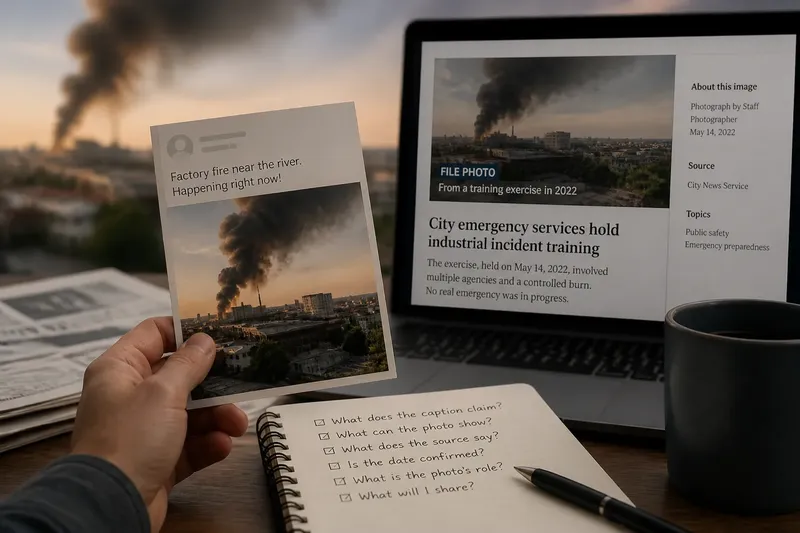
Say you see a neighborhood account post smoke above a row of buildings and claim a nearby factory is burning today. The starting evidence is only the posted image and its caption. You locate the news article credited as the image source, read its caption, and find that it identifies a controlled training exercise from an earlier occasion. The resulting judgment is that the photo may document smoke, but it does not support the account’s claim of a current factory fire; share the article’s context instead, or leave the claim unshared.
This distinction matters even when the image itself is untouched. A genuine photograph can be paired with a wrong date, location, or explanation, while an illustrative image can be relevant to a story without depicting its specific event.
Choose what to share
Before passing the post along, check each element and decide what to do next:
- Check whether the source caption names the same place; if it does, treat that detail as supported by the source, but if it does not, omit the place or seek another source.
- Check whether the caption identifies a specific occasion; if it does, compare that occasion with the post’s claim, but if it is missing, describe the occasion as unconfirmed.
- Check whether the image is labeled “file photo” or “representative”; if it is, present it as background rather than as a record of the current event, but if the role is unclear, use the source article’s wording.
- Check whether the article explains the cause the post asserts; if it does, attribute that explanation to the article, but if it does not, do not state the cause as established.
- Check whether the source page credits a photographer or organization; if it does, cite that source when sharing, but if no source is identifiable, avoid presenting the image as verified documentation.
- Check whether the post adds a date not given by the source; if the source supports that date, retain it with attribution, but if it does not, remove the date or state that it is unknown.
A photo shared without context calls for a final editorial choice: does your own caption preserve what the source actually establishes? If not, link to the fuller reporting or leave out the image. The goal is not to distrust every photograph, but to stop an image from being made to say more than its evidence allows.